
Solar Pool Heating Troubleshooting Guide
Why Isn't My Solar Pool Heater Heating the Pool?
Article was written by Gregory Grochola (physicist) - last updated 17/10/2026
Is your solar pool heating system technically working, yet it's not quite boosting the water temperature to what you expect? In this guide we go through a comprehensive troubleshooting procedure to help you track down why your solar pool heating system might not be working as efficiently as it could be.
Table of ContentsClick Heading Titles to Navigate Up or Down
Do a hot spot check: solar mats or panels should be cool or only slightly warm to the touch. If sections of your collector are hot to the touch, that means there is insufficient water flowing through that section. To perform a hot spot check, jump up on your roof (if you're confident and it's safe to do so) at 12 noon with the sun blazing down on your collectors and the system running, and run your hand over all parts of the collector system.
Do you feel any hot regions? If yes, your collectors are bleeding heat to the sky and are not working as efficiently as possible. All materials emit something called black body radiation, and the hotter the material is the more heat will bleed off it.
If you do a hot spot check and the collectors are cool with the sun blazing on them, then you can be confident they are pulling the heat off the roof and into your pool. Our installation manuals describe the same check, see Checking for Balanced Water Flow in the OKU panel manual or the PoolMasterPro strip manual.
An Important Note on Safety
You should only get up on the roof if you're confident of doing it safely. If you need to get up on a pitched two story roof and you are not 100% confident, best leave it to the professionals, as you should never underestimate the chance of a fall.
Sometimes the system is not quite set up correctly, perhaps there is no third balance pipe installed on a strip heating system. Check here for how not to set up a strip system, and here for how not to set up panels. Common issues include air locks, inappropriately sloped collector sections (depending on the collector type) and short circuiting situations where the bulk of the water only flows through one part of the collector array.
Sometimes strips are installed without a filter (it's sometimes called an in-line strainer) and they get twigs and gunk inside, so check the water flow through them. Some studies also show that there must be a minimum flow rate through the tubes to push air out of the tube system. This is more of an issue for strips with a larger bore than 8mm, but if your strips sag across a Flatdek valley, this combined with low flow can also create air locks in the tubes, where some tubes will not have flow in them due to an air lock.
A related topic is insufficient flow in general. A slow water flow will not strip heat off a collector system as well, but it also doesn't turn the pool water over sufficiently, so the hot water that comes out of the return line will just float to the top and cool excessively.
Did you know that for every 1°C increase in the top surface water temperature, you need 20% extra collector area to offset the extra heat loss? All the heat loss mechanisms for a pool - radiation, evaporation and convection - are strongly dependent on the top water temperature.
Check the temperature differential from suction to outlet, it should only be a 2-3°C boost and the flow should be fast. If it's closer to a 5-10°C boost with a slow flow, that's not efficient at all.
We mentioned that strip collectors sometimes run with a slower flow, as they have to push water through tiny tubes, and this can create a larger temperature differential. If you have one of these systems and you can't increase the flow, it's handy to run your filter pump right up to the late afternoon and direct the return flow downward to help mix the warm layer of water that develops during the day. This stops the excessive losses overnight to some degree and offsets the inefficiency in the system. See also our post on removing your pool's eyelet socket.
Check that your controller is turning your system ON at an appropriate time in the morning, roughly around 10am in spring, or 9am or so in summer, and turning it OFF when the roof gets colder.
Sometimes people install the roof sensor on the actual collectors themselves, and this is a big no-no. The roof sensor needs to measure the heat available to the collectors, and if you install it on a collector it will cool as soon as water hits the collectors and fool the controller into thinking the roof is cold. See Installing the Roof/Hot Sensor in the OKU panel manual or the PoolMasterPro strip manual for where it should go.
Sometimes the roof sensor is installed facing the wrong roof angle. It should be installed on a section of the roof facing the same compass direction as the collectors themselves.
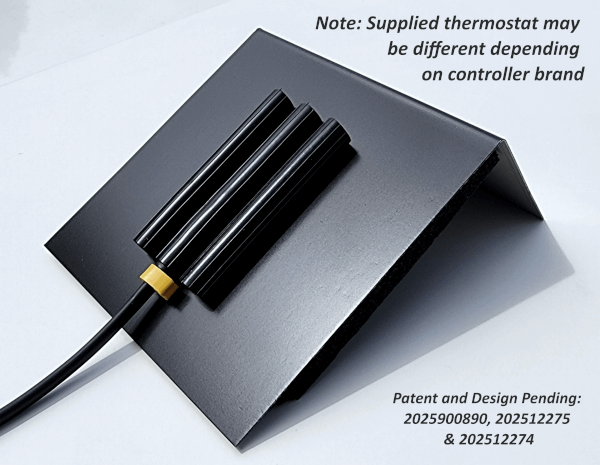
If your collectors are split across two different angles, preferably the sensor should be mounted on a black plate with insulation, splitting the angle. See our angled thermostat warming plate.
Sometimes people expect manual operation to produce the same heat as an automatic system, but that's not the case, as an automatic system will be able to turn the system on and off whenever it clouds over, preventing cooling over spring and autumn. See our pool solar controller guide for the options.
Secondly, are you running the solar intermittently, i.e. over the weekend only to heat up a pool? This will also produce dramatically lower pool temperatures, because people don't realize that the ground around the pool contains a great deal of thermal mass.
A solar system that runs non-stop will take about a week to get the pool to a new equilibrium, warming the ground up as it sucks heat out of the pool, to a point where, once the ground around the pool is warm, the pool stops losing heat through the walls excessively. Try to warm it up on Friday hoping to have it warm on Sunday and you'll find the cold ground will suck the heat right out of the pool.
If you've moved into a place and the heating is underwhelming, do a quick Google Maps check of your collector install angle (Google Maps shows north facing up). Collectors facing south-west or south-east are severely affected in the amount of sun they'll get. Collectors facing south, even on a shallow angle, are next to useless (unless you're up north).
They may look like they get sun, but the efficiency curve of a solar collector is affected by the total radiation on the collector. If it drops from ~1000 W/m² (north facing at noon) to say only ~600 W/m² at noon on a steep, poorly facing roof, then add any cold wind on those collectors and you're hardly collecting any heat, even though it looks like there is sun.
If your collectors are mounted incorrectly you may need to reposition them. See our write up on the optimal roof aspect angle for pool collectors.
Some people or installers get it wrong. The Australian Standard (AS 3634) kind of gives a flat, near 100% sizing recommendation without taking into consideration the heat loading characteristics of the pool in question. We questioned this at the last round of pool heating standard changes, but our changes were not adopted.
Our sizing calculator and water temperature simulator do a great job of boosting collector sizing when there are multiple adverse heat loading conditions, and sizing it down whenever they can to prevent oversizing. Try it and see what sizing and what pool temperature you get, and compare it to the collector size you have. You may need to add more collectors, or you may find there is a heat loading factor that's severely affecting your pool, like wind/sheltering (which is a large one) or shading.
Speaking of shading, did you know 90% or so of the sun falling on a pool is absorbed into the pool, and hence for every 1 m² shaded across the day you'll need 1 m² worth of collector to replace the heat? Shading is a large factor. Is your pool shaded? That might explain why it's so cold.
Another large factor is wind exposure and local area factors. Wind will strip heat off the surface of a pool very quickly through evaporation. This might explain your pool as well. The simulator lets you set how exposed or sheltered your pool is, so have a play with it.
Did you know using a solar blanket can double the heat you get from a solar pool heater? The solar puts the heat in, but a solar blanket works on the other side of the heat loading calculation - the heat loss side. This is especially so in spring and autumn, or for cold-night country areas where it gets very cold overnight. See why use a pool cover with a solar heater.
Or you might have purchased one of the black or silver lined solar blankets that we harp on about, see our blog post here. We've got some bad news for you: that was a terrible purchase. These blankets will cool your pool dramatically, and you should be mad, as there are unscrupulous people selling these without telling you how much extra you'll pay in heating through the amount of sun they reject.
Constant bubbling in the return outlet to the pool while the solar is running means the vacuum release valve on the roof is at negative pressure and is drawing in air. This happens when the pump height is substantial and/or you have more than one return outlet to your pool, so the pump can't positive pressurize the vacuum release valve.
The fix is to constrict the return line with the down draft/brake ball valve in small increments until the bubbles stop, and if you need to constrict it by more than 50% you'll need a stronger pump. DO NOT remove or drop the level of the vacuum release valve to stop the bubbling, it MUST be mounted as specified so the collectors are not pressure worked. See the full procedure in Negative Pressure and Air Bubble Issues in the OKU panel manual or the PoolMasterPro strip manual.
We've also seen some very dusty collectors. This will be dramatically affecting the collectors' efficiency, not only because the dust shades the collectors, but it also forms an insulating layer that takes the heat from the sun, heats up and doesn't pass it on to the collectors. Perhaps try washing the dust off, if it's safe to get up on the roof.
Installation Manuals
Service and Maintenance
Sizing and Performance Tools
If you've bought one of our systems and you're still stuck, contact us, our tech support is unlimited. And if your old system is beyond saving, have a look at our DIY solar pool heating kits.
Why is my solar pool heater not heating my pool?+
Work through the checks in this guide: hot spots on the collectors, a slow flow with a large temperature boost, the controller timing and roof sensor position, manual or weekend-only running, collectors facing the wrong way, an undersized system, shading, wind, no solar blanket (or a black or silver lined one), bubbling in the return line and dusty collectors.
Should my solar collectors be hot to the touch?+
No. With the system running at noon in full sun, solar mats or panels should be cool or only slightly warm. A section that is hot to the touch has insufficient water flowing through it and is bleeding heat to the sky.
How much warmer should the water coming back from the roof be?+
Only a 2-3°C boost from suction to outlet, with a fast flow. If it's closer to a 5-10°C boost with a slow flow, that's not efficient at all, as the hot water floats to the top of the pool and cools excessively.
Where should the roof sensor go?+
On a section of the roof facing the same compass direction as the collectors, never on the collectors themselves. If your collectors are split across two different angles, mount the sensor on a black plate with insulation, splitting the angle.
Can I run my solar on weekends only to heat the pool?+
Not effectively. The ground around the pool contains a great deal of thermal mass, and a system running non-stop takes about a week to warm it up to a new equilibrium. Try to warm the pool up on Friday hoping to have it warm on Sunday and the cold ground will suck the heat right out of the pool.
Why is my solar pool heater bubbling into the pool?+
The vacuum release valve on the roof is at negative pressure and is drawing in air, typically because the pump height is substantial or there is more than one return outlet. Constrict the return line with the brake ball valve in small increments until the bubbles stop, and see the installation manual for the full procedure.